
Collagen Supplementation and Tendinopathy: Helpful Adjunct or Overhyped Add-On?

Updated: Mar 13

Collagen supplements have become increasingly popular among runners and active populations dealing with tendon pain. Walk into any running store or scroll social media, and you will see claims that collagen can strengthen tendons, speed healing, or even prevent tendinopathy altogether.
As with most things in tendon rehab, the truth is more nuanced.
This article breaks down what we actually know about collagen supplementation in tendinopathy, where the evidence is promising, where it is limited, and how I think about using it clinically with runners.
Tendinopathy Is Still a Load Problem First
Before we talk supplements, we need to be clear on fundamentals.
Tendinopathy is primarily driven by a mismatch between load and tissue capacity. Progressive, well-timed mechanical loading remains the cornerstone of management. No supplement replaces that.
That said, tendons are living tissues. They adapt to loading through collagen turnover, extracellular matrix remodelling, and changes in mechanical properties. For that to happen, the tendon needs both the right stimulus and the right biological environment.
This is where nutrition, and collagen specifically, becomes interesting.
The Proposed Mechanism: Why Timing Matters
Collagen and gelatin supplements are rich in glycine, proline, and hydroxyproline, the key amino acids involved in collagen synthesis.
Mechanistic work has shown that after ingesting collagen or gelatin with vitamin C, circulating levels of these amino acids peak at around 30 to 60 minutes. The theory is straightforward:
If you ingest collagen, then apply a tendon loading stimulus while those amino acids are elevated, the tendon may have better access to the raw materials needed for collagen synthesis.
Importantly, this does not mean collagen builds tendon on its own. It is proposed to work by supporting the tendon’s response to loading, not replacing it.

What Does the Clinical Research Say?
Achilles Tendinopathy
One of the most cited clinical studies comes from Praet and colleagues. In this small double-blind crossover trial, people with mid-portion Achilles tendinopathy completed a structured calf strengthening program. During one phase they consumed specific collagen peptides, and during another they consumed placebo.
The collagen phase resulted in greater improvements in VISA-A scores compared to placebo.
This is encouraging, but it comes with caveats. The sample size was small, there was no imaging to assess tendon structure, and the study does not tell us that collagen works in isolation. What it does suggest is that collagen may enhance functional outcomes when combined with good rehab.
That distinction matters.

Patellar Tendon Adaptations in Training Studies
Several studies have looked at collagen supplementation in healthy athletes rather than in injured tendons.
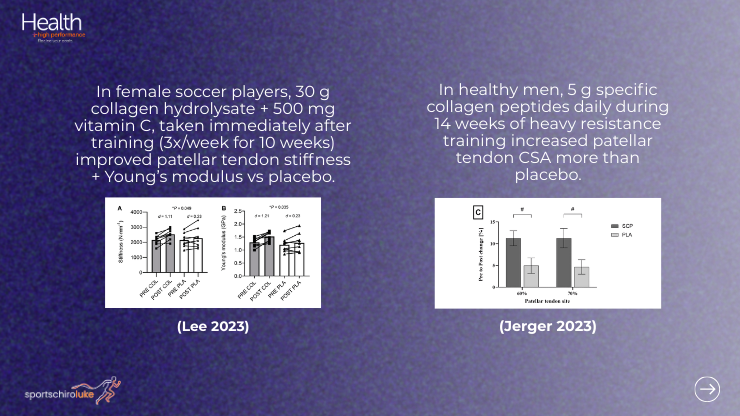
In female soccer players, collagen hydrolysate combined with vitamin C and resistance training led to improvements in patellar tendon stiffness and Young’s modulus compared to placebo.
Another study in healthy men showed greater increases in patellar tendon cross-sectional area when collagen peptides were added to a long-term resistance training program.
These findings suggest collagen can influence tendon mechanical properties under load. However, these were not tendinopathy populations. We need to be careful not to over-extrapolate structural changes in healthy tendons to pain reduction in injured ones.
What Do Systematic Reviews Conclude?
When the broader literature is pulled together, the message becomes more cautious.
Systematic reviews examining nutrition and tendon health conclude that collagen-containing supplements show promise, particularly when combined with exercise, but the overall quality of evidence is low to moderate.
Common limitations include small sample sizes, heterogeneous supplement formulations, inconsistent dosing and timing strategies, and varied outcome measures. Some mechanistic markers used in early work may also reflect bone collagen turnover as much as tendon-specific changes.
In short, the results are interesting, but it is not definitive.

Practical Application: If You Are Going to Use Collagen
If a runner chooses to trial collagen supplementation, I treat it as an adjunct to a well-designed loading program, not a primary intervention.
Two approaches are most commonly supported by the literature.
Option 1: Pre-Loading Strategy
Approximately 15 grams of collagen or gelatin, combined with vitamin C, should be taken around 60 minutes before a tendon loading session. This approach is based largely on mechanistic work and aims to align amino acid availability with loading.
Option 2: Post-Training Strategy
Around 30 grams of collagen hydrolysate combined with vitamin C, taken immediately after training. This protocol has been used in longer-term training studies showing changes in tendon mechanical properties.
If used, I generally suggest trialling collagen for at least 8 to 12 weeks alongside progressive loading, while monitoring symptoms and function rather than expecting rapid changes.

Who Might Benefit Most?
Collagen supplementation may be more relevant in runners who are:
Consistently completing tendon-specific loading programs
Managing high training volumes or cumulative tendon load
Struggling to meet overall protein or energy needs
Looking to optimise, rather than shortcut, rehab
It is far less likely to help if load management is poor, recovery and sleep are inadequate, or if the expectation is that a supplement will fix tendon pain on its own.

The Bottom Line
Collagen supplementation is not a cure for tendinopathy.
At best, it appears to be a potentially useful add-on that may help some runners get more out of their rehab when combined with appropriate loading, good recovery, and adequate overall nutrition.
Progressive mechanical loading remains the driver of tendon adaptation. Nutrition supports the process; it does not replace it.
As with most things in tendon rehab, context matters.
References
Baar, K. (2019) Stress–relaxation and targeted nutrition to optimize tendon health. Journal of Orthopaedic & Sports Physical Therapy, 49(9), pp. 668–675.
Balius, R., et al. (2016). "A 3-Arm Randomized Trial for Achilles Tendinopathy: Eccentric Training, Eccentric Training Plus a Dietary Supplement Containing Mucopolysaccharides, or Passive Stretching Plus a Dietary Supplement Containing Mucopolysaccharides." Curr Ther Res Clin Exp 78: 1-7.
Choudhary, S., Prasad, R., and Singh, A. (2021) Comparing the effectiveness of a combination of collagen peptide supplementation and exercise therapy versus exercise alone in chronic Achilles tendinopathy. Journal of Bodywork and Movement Therapies, 27, pp. 353–360.
Clark, K.L., Sebastianelli, W., Flechsenhar, K.R., et al. (2008) 24-week study on the use of collagen hydrolysate as a dietary supplement in athletes with activity-related joint pain. Current Medical Research and Opinion, 24(5), pp. 1485–1496.
Hijlkema, A., Knoop, J., van Mechelen, W., and de Vos, R.-J. (2022) The impact of nutrition on tendon health and tendinopathy: a systematic review. Sports Medicine, 52(3), pp. 467–491.
Jerger, S., et al. (2023). "Specific collagen peptides increase adaptions of patellar tendon morphology following 14-weeks of high-load resistance training: A randomized-controlled trial." Eur J Sport Sci: 1-11
Lee, J.K., Jang, K.-M., Kim, E.-J., et al. (2023) Collagen supplementation augments changes in patellar tendon properties following resistance training. European Journal of Applied Physiology, 123(6), pp. 1311–1322.
Praet, S.F.E., Purdam, C.R., Welvaert, M., et al. (2019) Oral supplementation of specific collagen peptides combined with calf-strengthening exercises enhances functional recovery in Achilles tendinopathy patients. Nutrients, 11(1), 76.
Shaw, G., Lee-Barthel, A., Ross, M.L.R., Wang, B., and Baar, K. (2017) Vitamin C–enriched gelatin supplementation before intermittent activity augments collagen synthesis. American Journal of Clinical Nutrition, 105(1), pp. 136–143.
Shaw, G., Slater, G., and Burke, L.M. (2019) Nutrition for the prevention and treatment of injuries in track and field athletes. International Journal of Sport Nutrition and Exercise Metabolism, 29(2), pp. 189–197.
Qiu, F., et al. (2022). "Does Additional Dietary Supplementation Improve Physiotherapeutic Treatment Outcome in Tendinopathy? A Systematic Review and Meta-Analysis." J Clin Med 11(6).


